A great brand system is only useful if people can actually use it.
This is where some of our most interesting Gen AI work is happening: turning expert creative judgment into tools clients can use to generate on-brand work for themselves — faster, more consistently, and without having to reconstruct the thinking behind the brand every time.
These tools empower an in-house creative team. They can carry forward a defined visual language, voice, or set of rules. They cannot decide what the brand should become, what the next campaign needs to say, which idea is worth pursuing, or when the system itself needs to evolve. That’s for the people who live the brand to explore and enforce.
The value is leverage: our experienced Focus Lab creatives define what right looks like for a new brand, and Gen AI helps make more of that judgment usable after handoff, giving in-house teams a leg up on brand implementation.
{{divider}}
Huntress: Snapshots from a cyberpunk universe
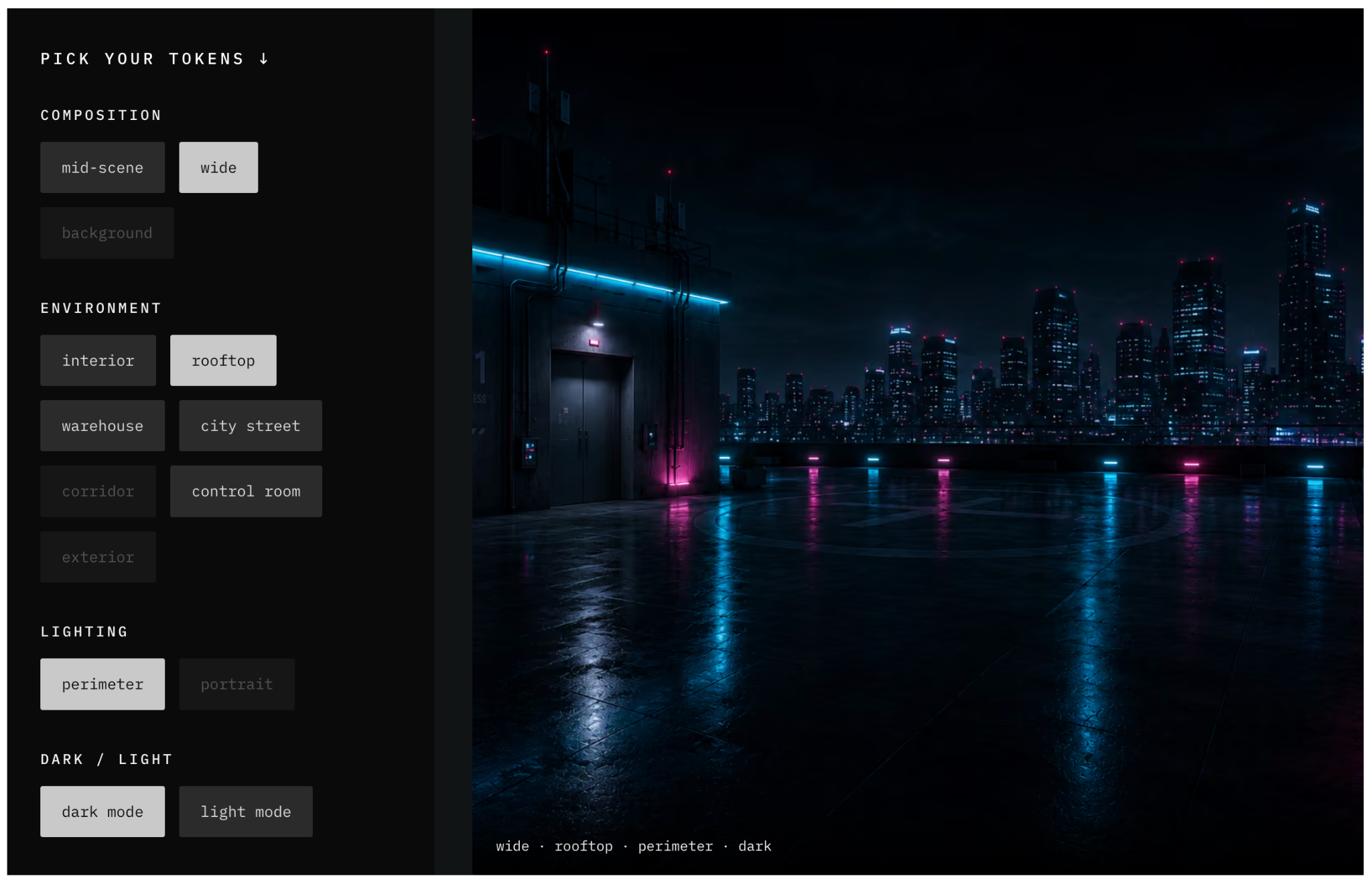
Here’s one way we did this. Design Lead Stetson Finch built a Gemini tool for enterprise cybersecurity company Huntress that lets them generate on-brand images with a simple four-word prompt.
Composition, location, subject, lighting. Enter these into the tool Stetson built and Huntress gets a picture from the “Huntress universe,” a cyberpunk world they imagined for their brand. A little dangerous, like the very real cybersecurity threats they protect against. A lot exciting: vivid, more like a movie than a stock photo.
Art direction for a movie is a lot like how Stetson created this custom tool. In effect, he told the AI a story about Huntress: who they are, what their world should look like. He provided masses of context, reference images, project strategy — using, of course, the appropriate privacy and data controls. He fooled around on multiple tools, exploring what he got from each and sometimes feeding results from one into another (this is a trick a lot of us use to shake out new possibilities when one tool gets stuck in a rut).
He had to define everything, from the lighting accents (neon pink and blue, straight from the brand guidelines) to the precise level of dampness of the city streets, so they would reflect that light in a way that felt moody and exciting, rather than just wet. Described, quantified, encoded into rules an image generator could replicate over and over again. Reliability is important.
The simplicity is downstream, for the people using the image generator. The complexity lives in the tool Stetson built: a defined system that describes the visual language so precisely that it can turn just four words into an in-brand image. The value lies in the use Huntress gets out of the tool.
Look at Huntress’s live site, and you’ll see images from the moody Huntress universe. Huntress generated them with the tool — and each image looked like it belonged in the world he had designed.
That’s the payoff. The art direction didn’t stay trapped in Stetson’s head or in a static set of guidelines. Enough of the logic was encoded into the system that the client could keep creating new work without losing the brand.
{{divider}}
Maxio: Textured, tech-y ASCII art
Design Lead Shay Bocks went through a similar process in her work for billing management platform Maxio. She built them a tool that transforms a regular picture or video into a still or animated image composed entirely of ASCII characters.
One of Maxio's biggest concerns was ending up with a brand system that would be hard to use. A lot of companies go through this experience: the dreaded brand implementation gap. You create a new brand that looks and feels incredibly cool, but when it comes to actually making webpages and brochures and social posts, for one reason or another the brand proves incredibly difficult to get right.
Shay found visual inspiration at a workshop from award-winning branding and design agency Smith & Diction. She dug into Figma Make, exploring how it could turn an image, like a spinning coin, into a cool, textured, tech-y ASCII rendered graphic. But before she could even propose this direction, she knew she’d have to make it incredibly straightforward for Maxio to use.
So from the very first week, Shay proposed not just this element of visual language, but a tool that could generate these images, with the brand colors built in, and a very limited set of options. Input image, fiddle with the sliders to see what you like best, export.
Maxio loved it — the look and the ease of use — and Shay spent the next six weeks iterating to ensure that it would always generate on-brand images for Maxio. While we were talking, she checked the version number of the final image generator that shipped: 314.
The client doesn’t have to understand the complexity Shay encoded into the system. They just have to be able to use it correctly. The easier it is to use a tool — the longer it takes and the harder it is to build.
{{divider}}
Enterprise AI Company: Webpage drafting
As a Brand & Interactive Writer for Focus Lab, I’ve created prompts to help clients draft copy in their new brand voice across formats and platforms.
One client was a highly technical AI company that had outgrown its 2010-era brand. I worked with them to define a voice that went beyond technically accurate (but emotionally flat), then used it to write their homepage and key product pages.
Through that work, I learned the texture of how this company writes: the words they preferred or hated, the sentence rhythms that captured their cadence, and how to shift between big-picture arguments and granular technical detail, so they could speak to a CPO or a software engineer without losing either. I explored all of this, in depth, with Claude as my sparring partner.
At the end of the engagement, I created a tool that could produce writing in their brand voice.
But visual and verbal work are different. While Stetson and Shay’s tools can create images that are basically ready to go, my tool can’t produce publish-ready copy, but rather solid first drafts: something a person can react to, reshape, and improve.
It also takes more inputs: a person has to define the information that this generated writing is going to convey. What’s the thesis? What proof points do we want to use to support this argument? Who exactly are we targeting at this moment?
Using Gen AI throughout the engagement didn’t just help me work faster and more accurately (and accuracy mattered a lot here). It helped me turn the judgment I developed while writing for the brand into a tool the client could keep using, that could help them stay on brand in their writing.
{{divider}}
From experiments to a capability
A lot of this work started organically: a designer spotted an implementation problem, wondered whether Gen AI could help, and started tinkering.
Now we’ve seen enough value in those experiments that Focus Lab has made it someone’s job to turn promising ideas into real capabilities.
Thato Maselela is our generative AI experience designer. He joins projects when there’s an opportunity to extend a brand through a custom tool — sometimes because the client asks, sometimes because the creative team sees a problem that could be made easier to solve. His job is to figure out whether the idea is technically possible, which tools can make it work, and how to package the result into something the client can actually use.
That last part is where things get interesting.
For one client, Thato and another designer wanted to turn ordinary images into branded architectural-style drawings. Claude alone couldn’t do the transformation reliably. So Thato tested other approaches, found that Gemini handled the image work better, figured out how to connect Gemini through an API, and used Claude to build the interface around it.
The client didn’t need to know which model was doing what behind the scenes. They got one usable tool.
And building something usable means thinking beyond the flashy demo. How will the client access it? Does it need to run as an HTML file or an app? Will their security policies allow installation? How do API keys work? What quality checks need to happen before we hand it over?
This is increasingly Thato’s role: taking the experimental possibilities of Gen AI and engineering the path toward something reliable, usable, and worth putting in a client’s hands.
He’s also helping Focus Lab turn those experiments into a repeatable capability — documenting what we learn, building quality checklists, and thinking about how the rest of the team can get up to speed as the tools keep changing.
The experimentation is still real. Thato says that, unlike traditional design work, he doesn’t always know at the outset whether an idea will work. But that uncertainty is exactly what makes the role valuable: someone has to explore the possibilities, find the path that works, and turn it into something the rest of us — and our clients — can use.
{{divider}}
Not everything should become a tool
Not every useful Gen AI deliverable needs to generate something.
Brand & Interactive Writer Ware Carlton-Ford has been developing guidance for clients around how to use Gen AI well: Where it can genuinely augment the work, where its limitations matter, and where they should resist using it simply because they can.
We know clients are going to feed brand deliverables into their Gen AI tool of choice. So part of providing responsible guidance is explaining that guidelines written for humans are not, by themselves, instructions an AI can reliably execute.
A voice description, for example, can give an experienced writer useful direction because that writer also brings knowledge of the audience, messaging, company personality, context, and the thousand small judgment calls involved in good writing. Give the same voice description to Gen AI and ask for finished copy, and a lot of that context is simply missing.
So Ware’s guidance does two things at once: it helps clients identify places where Gen AI can genuinely extend their capabilities, and it sets realistic expectations about what the tool needs — and what it still can’t do.
That is implementation support, too. Sometimes the most useful thing we can give a client is not another generator, but a clearer understanding of how to use the tools they already have, without expecting them to supply expertise that isn’t there.
Brand Strategist Jordan Keller draws an even firmer boundary around strategy. Parts of strategic work are highly systematized: frameworks, questions, methodologies, ordered ways of examining a business. In theory, a lot of that could be encoded into software.
But that doesn’t mean it should become a self-serve “strategy bot.” A client might get an answer without knowing whether they asked the right question, when the framework applies, what context is missing, or whether the result is directionally sound. Keller’s work depends on understanding the client deeply enough to make and defend a recommendation. The framework can support that judgment. It can’t substitute for it.
{{divider}}
Build the brand. Build the handoff.
That distinction matters. An AI-enabled deliverable should make expert judgment more usable — not create the illusion that judgment is no longer required.
A brand handoff used to mean giving a client the rules and hoping they could apply them well. Increasingly, we can hand them some of the machinery, too.
That doesn’t make designers, writers, or strategists less necessary. It makes more of their judgment usable after the project ends — helping in-house teams close the brand implementation gap without losing the thinking that made the brand distinctive in the first place.
That’s the opportunity we’re most interested in: not generating more stuff, but building brands that are easier to use well.
228
Shirts Sold
Fuerte shirts purchased
$22k
Organization Matches
Additional funds donated by Focus Lab and partner organizations
$26k
Donated to UNIDOS
Total amount donated to PR relief efforts through UNIDOS
More than anything, we want people to succeed, professionally and personally.
More than anything, we want people to succeed, professionally and personally.
Never miss a post.
Sign up for our occasional newsletter. No spam. Unsubscribe at any time.
Thank you! Your submission has been received!
Oops! Something went wrong while submitting the form.
By clicking the submit arrow above, you consent to allow Focus Lab to store and process the personal information submitted above to receive the In Focus newsletter. You can unsubscribe at any time. For more information, please review our privacy policy
By clicking the submit arrow above, you consent to allow Focus Lab to store and process the personal information submitted above to receive the In Focus newsletter. You can unsubscribe at any time. For more information, please review our privacy policy