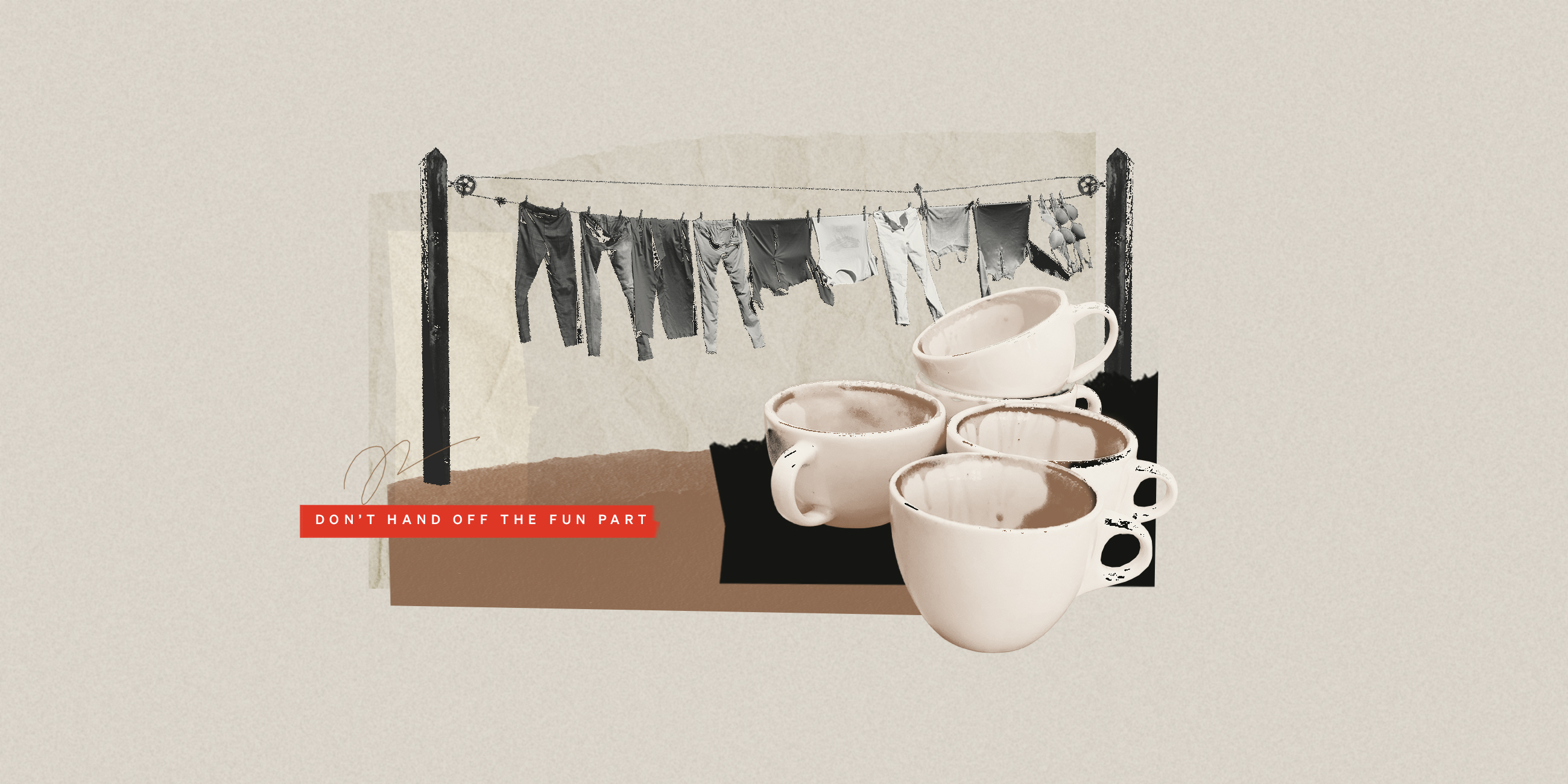
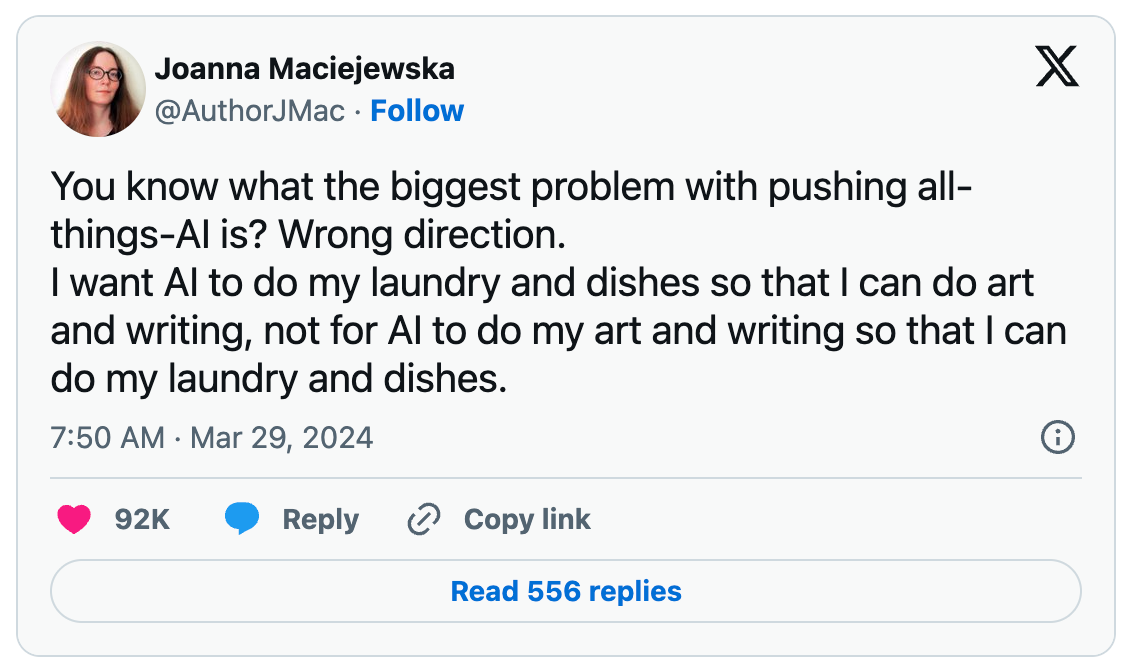
Writer Joanna Maciejewska aptly put it like this: “I want AI to do my laundry and dishes so that I can do art and writing, not for AI to do my art and writing so that I can do my laundry and dishes.”
That distinction gets pretty close to one of the useful ways that we use Generative AI at Focus Lab.
Creative work contains a lot of work that is not, itself, especially creative. Check every spacing variable. Find the off-brand color you tested out three rounds ago. Dig through all those transcripts to find the quotes that support this conclusion. Compare a phrase against the established voice. Make sure the terminology is consistent. Apply the same transformation to another image. Do it again. And again.
These are places where Gen AI can take on repeatable, codifiable work at a scale that would consume enormous amounts of human attention. The point isn’t to remove the designer, writer, or strategist from the process. It’s to spend less of their attention on the parts a machine can check or repeat reliably — and more of it on the decisions that require taste, judgment, context, and an actual point of view.
{{divider}}
QA for design systems that scale
Design Lead Shay Bocks uses Claude to do quality assurance (QA) checks on her files. She likes a tight design system, brand colors and shades built in, everything connected to a variable. So after a building session, she’ll run a QA check.
That check runs against a set of standards that the design team collaborated to define, and they exist partly because designing with AI is messy. Claude moves fast and drifts. A check ensures that Claude can catch its own mistakes.
One time, Claude found 1700 errors.
These aren’t big errors. They’re tiny, unnoticeable even. Is the padding on that block correct, and does it fit into the correct multiples, so everything can scale up or down efficiently? Is there a consistent visual hierarchy? Shay builds systems where every element fits with mathematical precision.
But during the actual building, pixels can easily go astray. Shay asks Claude to check whether the system that she’s defined is being applied correctly. Then it fixes the easy stuff and asks Shay for judgment calls on the rest. Every now and then, Shay will jump in herself to make a bigger repair.
These super small details matter to the developer who is going to spend hours coding Shay’s design into an actual webpage. The attention to detail she’s able to apply at this level makes the downstream work function better — and avoids the brand implementation issue of elements that look as if they should work together but don’t. This level of QA would be close to impossible without Gen AI — or it would certainly take a prohibitive amount of time and human attention.
Pattern matching. Repeating behaviors. Change all the reds in this file to a different red — not that one, this one. Check the measurements. Are the numbers all multiples of eight? Great.
{{divider}}
Alignment and analysis of the written word
As a Brand & Interactive Writer, I have my own laundry and dishes that Gen AI can do. A language system has its own precise rules and dependencies: Preferred vocabulary, audience calibration, sentence rhythm, product terminology, approved claims, phrases to avoid, distinctions that matter. One inconsistency may be harmless. Enough of them, and the voice starts to drift. We humans are highly verbal, and we sense it when someone doesn’t sound quite like themselves. It’s the same with brands: Voice drift makes your brand less coherent and less trustworthy.
Once I’ve built and defined a voice or messaging, Gen AI is very good at checking those repeatable, codifiable things. Is this the vocabulary we defined? Does this product claim match the source material? Is the register right for this audience? Did we use the same verb six times on this webpage? Is this message following the voice rules we established?
This is QA for a verbal system. Once we’ve defined what “on brand” means, Gen AI can inspect new work against those patterns and flag where the execution wanders outside the boundaries.
Then the writer makes the judgment calls. Maybe the technically correct word is still the wrong word for this context. Maybe breaking a voice rule makes this sentence better. Maybe the repetition is deliberate. The machine can identify the deviation; it can’t decide whether the deviation is a problem.
That division of labor matters as more people begin using a verbal identity. The system can check for consistency at scale. The human decides when consistency serves the work — and when the better choice is to break the rule.
{{divider}}
Cleaner, leaner strategy work
Brand Strategist Jordan Keller has his own category of laundry and dishes: Condensing, organizing, and moving information around, once he already knows what the work is supposed to do.
Strategy work produces a lot of words. Research, transcripts, notes, analysis, speaker notes, draft slides. Keller is happy to use Claude to compress some of that material into a more usable shape. After reading through absolutely everything at least once — he sets aside Claude-free time once a week, for exactly this purpose — he can then ask Claude to summarize and condense around specific subjects, across sources, delineating chunks of material for him to work from. What did each interviewee have to say about this particular subject? Claude knows, without Keller needing to dig through reams of material.
He uses Claude’s ability to condense on the writing side as well as in research and exploration. When you’re writing custom strategic insights, it’s easy to go long. When Keller realizes that he’s drafted something that’s simply too wordy for a slide (slides are a form unto themselves, just as much as a song or a sonnet), he can ask Claude to cut 50 words without adding anything new, then review the shorter version and make sure it hasn’t flattened an important distinction.
This editing function cuts time out of the process. Not just writing time: The time between writing sessions. It’s very difficult to go from a long, carefully crafted draft to a much shorter one in the same afternoon. A tool that ruthlessly trims that lovely turn of phrase because it saves you seven words is helpful, if sometimes infuriating. A person working wrangling ideas into sentences needs distance — usually a good night’s sleep — to get their brain to acknowledge that the phrase isn’t doing enough heavy lifting to earn its place.
Keller also uses technical integrations as a useful shortcut to build slides. Once the content and structure are settled in his mind — and on the page — he can give Claude a link to a Figma frame and ask it to organize the material on the slide while he moves on to another task. Sometimes the layout is usable. Sometimes, “it makes a mess.” Either way, the task is execution, not direction.
The distinction matters. Keller is comfortable handing off work when he already knows what a good result should look like. Move this information here. Make this shorter. Distill these fourteen pages of speaker notes into the few points the audience actually needs, based on this blather from my brain. Those are constrained jobs he can quickly evaluate when the results come in.
What he won’t delegate is what he calls “insight, direction, conviction.” Keller has to understand the client well enough to diagnose the problem, articulate a direction, and substantiate why he believes it’s right. Then Claude can help him with some simple execution tasks.
For Keller, Gen AI can shuffle the pieces, compress them, clean them up, and put them where they belong. He keeps his attention on deciding which pieces matter — and what they should add up to.
{{divider}}
“… So that I can do art and writing”
What we all have in common is a fundamental desire to do the thinking, the art, and the writing ourselves. This makes sense from a personal perspective: Shay, Keller, and I all built our creative careers because we love making things. Of course we don’t want to hand the fun part off to a machine.
But this also makes sense from the craft perspective: We have creative careers because we’re exceptionally good at the creative part. Talent, honed by practice and experience. Taste, refined by deep knowledge. Judgment about what makes the final outcome effective. A point of view on how to present each unique client in the most appealing way.
This is exactly where Generative AI doesn’t excel. Examples of the slop these tools produce without taste, judgement or experience as guides are widely on display. More and more, we see people hating on Gen AI because it makes slop so easy to instantiate, with very little time or effort, thought or care.
We’re against AI slop. Do we use the tools at our disposal to help make the magic happen? We sure do. But the magic itself? That’s all us.
228
Shirts Sold
Fuerte shirts purchased
$22k
Organization Matches
Additional funds donated by Focus Lab and partner organizations
$26k
Donated to UNIDOS
Total amount donated to PR relief efforts through UNIDOS
More than anything, we want people to succeed, professionally and personally.
More than anything, we want people to succeed, professionally and personally.
Never miss a post.
Sign up for our occasional newsletter. No spam. Unsubscribe at any time.
Thank you! Your submission has been received!
Oops! Something went wrong while submitting the form.
By clicking the submit arrow above, you consent to allow Focus Lab to store and process the personal information submitted above to receive the In Focus newsletter. You can unsubscribe at any time. For more information, please review our privacy policy
By clicking the submit arrow above, you consent to allow Focus Lab to store and process the personal information submitted above to receive the In Focus newsletter. You can unsubscribe at any time. For more information, please review our privacy policy
Read what's next.
Artificial Intelligence
Gen AI Can Do the Laundry and Dishes. We’ll Keep the Art
by
Nadine Kavanaugh
9
min read
•
October 21, 2026
Brand Strategy
Why Choosing a New Logo Feels So Hard
by
Nadine Kavanaugh
3
min read
•
April 7, 2026
Artificial Intelligence
Gen AI Can Do the Laundry and Dishes. We’ll Keep the Art