When your team’s bored, your audience is just waking up
There’s a moment after a rebrand when your “new” brand doesn’t feel so new anymore.
You’ve been living within it for months. You’ve now seen the same colors, same typography, same patterns a hundred times, and it’s starting to feel stale. The internal hype fades. Your creative team starts to itch for something fresh. This is natural.
“Your team has viewed the content hundreds of times, yet it will take months for your target audience to see it the 12+ times it takes to break through the noise.”
It’s easy to forget that while you and your team are already on round 500 of this brand, your audience is just getting to round three. They’re not bored, they’re barely familiar. Read that line again.
That’s the paradox of internal brand fatigue. By the time you feel ready to add a new color to spice things up, your market is only beginning to recognize you.
This is why I always tell clients: Don’t mistake your own repetition for your audience’s saturation.
Of course, evolution is important. Brands that never flex eventually feel rigid or irrelevant. But the goal is evolution with continuity, deepening the system you already have, not abandoning it (or diluting it) out of boredom.
If your team’s feeling restless, that’s a good sign. It means the brand is alive. Just make sure you’re not chasing change for your own relief instead of your audience’s reality.
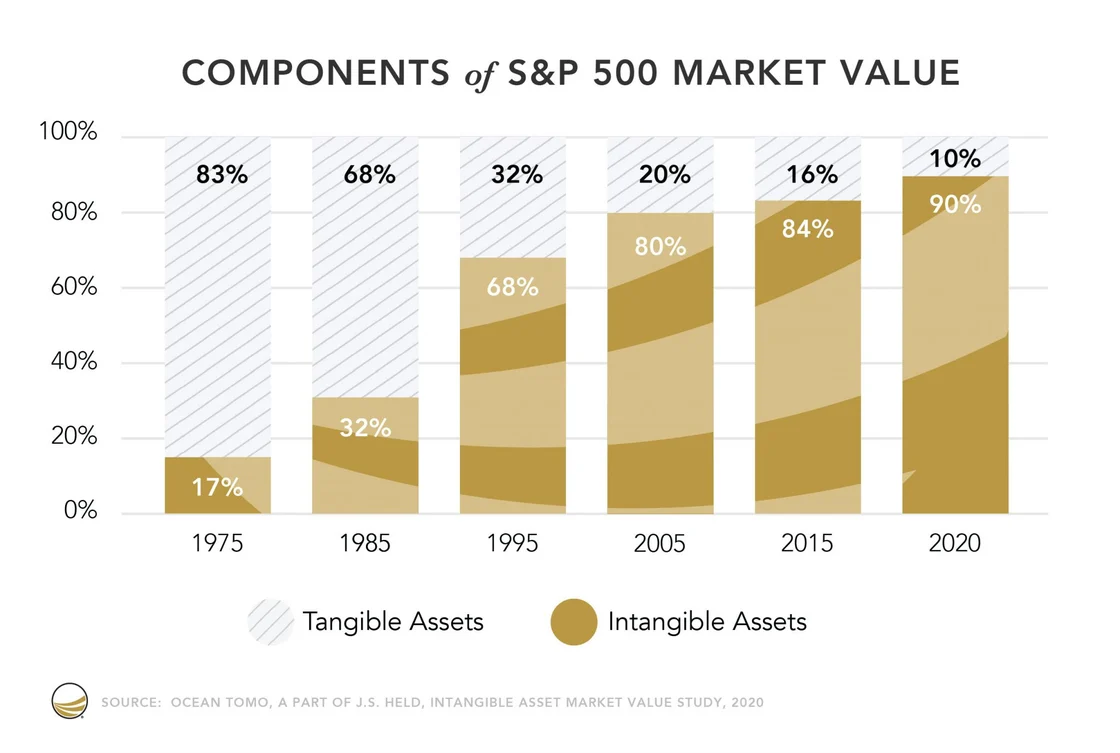
A company’s future value increasingly resides in what can’t be touched: its intellectual property, technology, and brand. See Ocean Tomo’s Intangible Asset Market Value Study, which shows intangible asset value rising to nearly 90% of S&P 500 market value in 2020.
While patents and technology drive innovation, brand amplifies their value by creating trust, loyalty, and a unique connection that competitors cannot replicate. In B2B and consumer markets alike, strong brands make intellectual property and products discoverable, meaningful, and profitable — turning potential into market leadership.
“‘Brand’ in this world is far from being a static set of words in a strategy document. It’s a dynamic network that simultaneously builds and refreshes human memory structures while being constantly interpreted, reproduced and represented by machines.”
“You have to form that emotional connection, and the work has to be creative and interesting,” [Dara Treseder, Autodesk’s chief marketing officer] explains. “Gone are the days when business-to-business is business-to-boring.”
“Inbound leads cost up to 61% less, which means the brand is doing heavy lifting before a single sales call. In fact, 92% of B2B buying journeys begin with an online search; and the buyer is researching, comparing, and assessing before your sales team even engages.”
“Measuring brand ROI isn’t about proving that branding ‘works’ — the research and case studies already demonstrate that. The critical task is connecting brand activity to the metrics executives care about: awareness, pipeline, trust, margin, and enterprise value.” 👏👏
Metaforce’s Allen Adamson explains, “[B2B customers] are not just evaluating products — they're managing risk, navigating internal politics, and trying not to make a mistake that could haunt their résumés.”