The Jevons paradox, aka the Jevons effect, occurs when technological improvements that increase the efficiency of a resource's use lead to a rise, rather than a fall, in total consumption of that resource.
A LinkedIn comment served this up in response to a "what if?" question I posed.
I love a good "what if?". It forces you to silence your biases and fixed opinions, and simply wonder for a moment.
We're surrounded by too many absolutes these days. This is bad. This is good. I don't get down like that (or at least I try not to). In reality, our world is not that polar, yet we jump to final conclusions based on our mood, personal experiences, and the influence around us. Asking "What if …" allows us to dream more freely.
For instance, I asked LinkedIn, "What if … AI expands the appreciation and need for good strategy/writing/design? Not being the villain trying to kill it."
Everyone is so resolved that AI is bad for companies like mine that I cannot help but wonder: what if it's good? Not good in terms of "creating outputs faster." I mean good in the Jevons paradox example: in total consumption of a resource.
If everyone is now actively trying to use AI to build their brand strategy, brand messaging, and brand visuals, will that rise in "consumption" put an even greater attention on the value of those outputs, the appreciation for the complexity, and the gaps of what AI can and cannot create?
Will AI put a spotlight on just how much brand matters now and in the future?
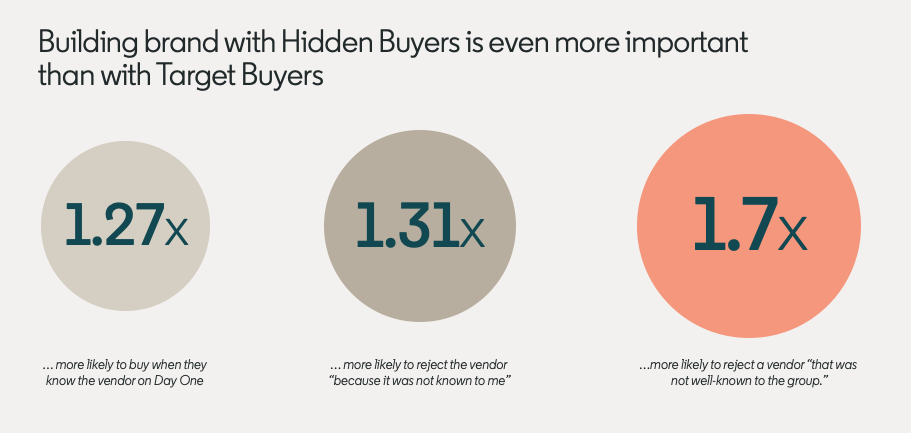
The LinkedIn B2B Institute found that hidden buyers care more about reliability and reputation than product features. "Hidden Buyers are much more influenced by brand than Target Buyers and are 70% more likely to reject brands that are not well-known to others and 31% more likely to reject brands that they themselves do not know. Once again, brand knowledge or lack thereof is the threshold of vendor rejection."
"If your brand strategy is static while your business is dynamic, you aren't just standing still. You're falling behind." Early-stage, growth stage, and scaling companies need their own brand strategies, but that doesn't always mean a full rebrand. Sometimes it's strategic evolutions and revisiting positioning.
"'The biggest myth about AI is that it's the panacea [that] will solve all of our problems,' she said. 'If you take the human out of the loop and forget that you need to make sure it feels human, it feels authentic, like your brand, you will fail.'" Over-reliance on AI is a quick way to lose brand trust.
"B2B is operating in a market in which AI is multiplying sameness. Average content is easier than ever to produce. Safe work is everywhere. And when everything starts to sound polished, polished stops being persuasive. The brands that rise are the ones that create memory, meaning and momentum before anyone is officially 'in market.'"