A year ago, I shared an experiment on LinkedIn: “If AI can create a shockingly accurate headshot for you, are you conflicted about using it? Does it make you less human?” I paired it with my own AI-generated headshot. The post took off: 17,000+ impressions, 100+ comments, and a wide range of reactions.
Some said, “Looks great — mine’s AI too!” Others were more skeptical: “It’s good, but it feels … empty. Like something’s missing in the eyes.”
“Maybe the real value of an image lies elsewhere. When tools are so easy to use, truth becomes harder to find.” That statement stuck with me. While my new AI-generated headshot accomplished my goal that day (a quick and cost-effective avatar), it wasn’t authentic.
People, like brands, thrive on authenticity. Especially today.
We live in a world where anything can be manufactured: attention, aesthetics, even emotion. AI gives us infinite content. Flawless renderings. But in that flood of sameness, authenticity has become an increasingly valuable asset.
So, when I got the news about being featured on the cover of Branders Magazine last month, I knew it was time to ditch that cheap solution and invest in something more authentic (shoutout to Carrie Nelson and Steven Picanza). Reminded of the power of an imperfectly genuine photograph, I was hungry to capture the real me. There’s a story in every real wrinkle and subtle expression. There’s energy and spontaneity that AI just can’t capture.
Here’s the broader takeaway: Your brand — personal or corporate — isn’t just a logo, a tagline, or a perfect-looking headshot. It’s the story people believe about you. And in an era when polished pixels are cheap, what people are really craving is proof of soul. A reason to believe that what you stand for is rooted in something real.
AI is a tool. Trust is the strategy.
Authenticity isn’t just a brand value — it’s the brand advantage.
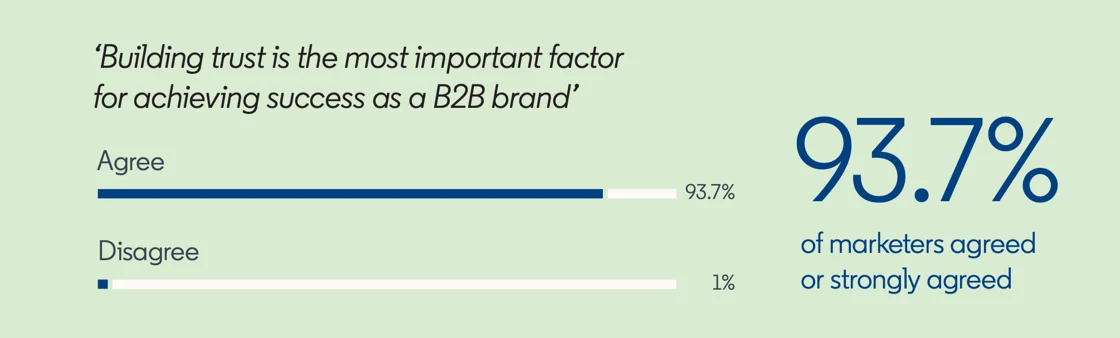
“Building trust in a B2B brand isn’t just a tactic. It’s the strategy.”
During our brand attribute exercise, we often steer partners away from choosing “trustworthy” as a defining trait. Not because trust doesn’t matter (it absolutely does) but because it’s table stakes. Every brand should look and sound trustworthy. It’s a baseline expectation, not a differentiator.
A LinkedIn survey of 1,500 marketers found that the most effective way to build trust is through customer recommendations. That’s not something a logo or tagline alone can earn.
We’ll always deliver visual and verbal identities that convey credibility. But branding is just the beginning. We can help our clients talk the talk — it’s up to their team to walk the walk and prove, day in and day out, that their company is one worth trusting.
“At the heart of great B2B work is creative courage, anchored in clarity. The kind of work that knows exactly what it wants to say and expresses it with originality, emotion, and intent. In B2B, where complexity is a given, it is the ideas that distill, not dilute, that rise to the top.”
"Today's B2B marketers realize they're not just pitching to businesses—they're pitching to real people who want to feel connected, engaged and understood."
Microsoft, Amazon, and NVIDIA are the world’s most valuable B2B brands in 2025, but the more interesting data point is the rise of B2B in general. “This year, the total brand value of the top 150 B2B brands has risen by 8% year-on-year, representing a near quarter-trillion-dollar increase.”
“To drive growth in an AI-saturated, attention-poor market, we need to refocus on what really moves the needle: building a brand that stands out, connects with buyers and earns trust.” 👏👏👏