"A slow drift to the middle kills many great brands." — Jon Schleuning
Jon's right. And the scary part? Most companies don't see it happening.
The drift to the middle isn't a decision. It's a slow accumulation of small ones, and each move feels reasonable in isolation.
You add a feature because your competitor did. You broaden your positioning to capture a new segment.
Here's what makes it so dangerous: the middle feels safe. It looks like maturity. It presents itself as a strategy. But it's a mirage.
The middle isn't a market position — it's where brands go when they stop believing in their own point of view.
The companies that win stay on the edges. They're specific about who they're for. They say things that not everyone agrees with. They make positioning choices that close doors on purpose.
That's not recklessness. That's conviction.
When your brand stops standing for something distinct, it starts standing for nothing. And nothing doesn't win deals. Nothing doesn't attract great talent. Nothing doesn't build a category.
The drift to the middle is a defense posture.
Defense doesn't build brands. Conviction does.
So here's the honest question: Is your brand getting sharper over time, or softer? Are you leaning into your point of view, or quietly hedging it?
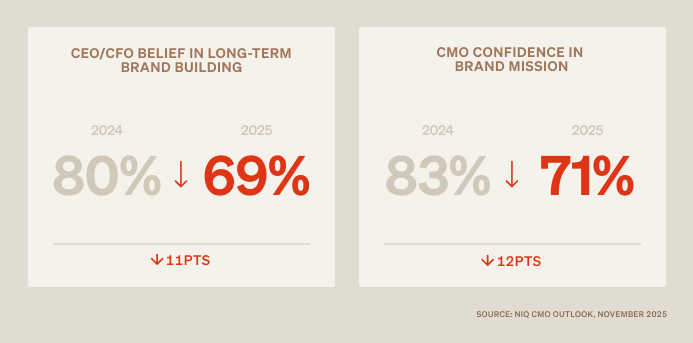
According to NIQ's 2026 CMO Outlook, "69% of CMOs say their CEO and CFO believe in the value of long-term brand building—down sharply from 80% last year." It's a familiar cycle. Economic pressure arrives, ROI demands follow, brand budgets shift to performance marketing, short-term wins come in, and long-term equity quietly erodes. By the time the damage shows up in the numbers, it costs far more to rebuild than the cuts ever saved.
"Salience — being remembered at the moment a decision is made — actually drives choice. [...] People are bored. So, they'll remember the pink brand with the raccoon mascot — not the forty-seventh blue one they saw this week."
"Their research across more than 100,000 ads shows that brands with long-running creative platforms (recurring characters, scenarios and tonal signatures) build emotional equity that compounds. Campaigns featuring a fluent device are 73% more likely to report a large profit gain than those without."
"A strong narrative asset can be reused, expanded, licensed, and reactivated over time. It can anchor partnerships, inform product lines, fuel community formation, and power live experiences. Its value compounds rather than expires." We wrote about something similar and the value of intangible assets.