Sameness in branding is not new. The slow drift toward the safe, the proven, the already-seen. Largely driven by emotional security versus strategic certainty. It's a story as old as time.
What is new is how AI will accelerate this messy middle. As more founders run towards AI as a creative output machine, they will realize something very clearly: AI doesn't invent difference. It regresses to the mean.
Feed it the internet and it hands you back the internet, averaged, smoothed, stripped of edges. Every brand pulling from the same well ends up tasting like the same water. But brands need flavor.
The paradox: AI is ridiculously powerful, and for many tasks it's a total unlock. We're experiencing this firsthand at Focus Lab. But when it comes to building a brand foundation, it's a flattening machine. AI doesn't differentiate brands; it dissolves them.
The brand differentiation gold rush is coming. We're standing at the edge of a creative renaissance, and it's being forced into existence by the technology that was too quickly labeled as the villain threatening to kill it.
Being different used to be a brand choice, reserved for the companies brave enough to leap. That era is over. Distinctiveness will now be table stakes. That's a good thing. There's no more hiding in the middle. The middle is where the AI flattening lives and dies.
Companies that spend the time and money to get their brand foundation right will be the ones who win on both sides of the paradox. They will be empowered to feed AI something worth protecting: full brand systems, trained deeply. Ensuring what comes out the other side is rich and valuable. Instinct, encoded.
FWIW, I'm jacked up about this future and what it means for our company and our clients.
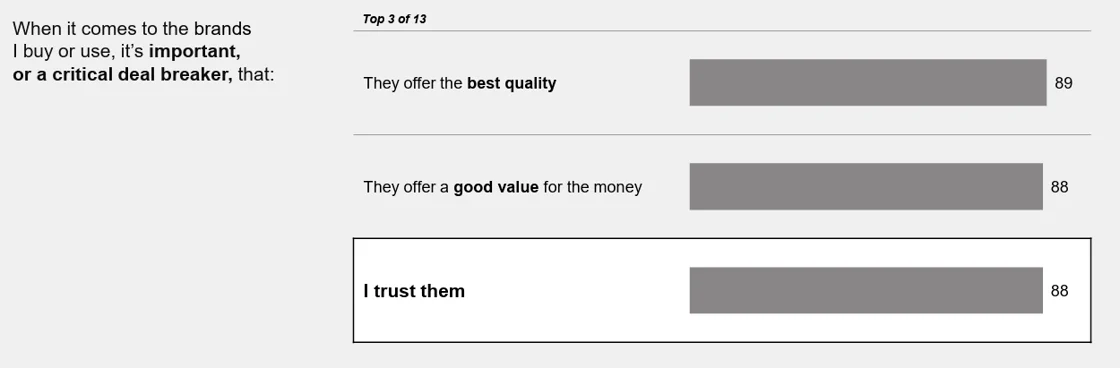
Consumers now weigh whether they trust a brand as heavily as whether it's good (89%) or affordable (88%). We've talked about the importance of trust in this newsletter before, with 94% of marketers agreeing trust is the key to B2B success, and how it's table stakes. Trust is a prerequisite, not just a "nice to have" anymore. As CEO Richard Edelman writes, "The combination of trust and relevance effectively doubles a brand's growth potential in a way that neither can alone."
"When you only concentrate on numbers and deliverables, a brand can lose its way because you start to make decisions that are financially based, not necessarily narrative- or brand-based. [...] Brands are relationships, purely."
Since roughly 2005, "the things we could measure [clicks, opens, conversions, cost per lead, etc.] became the things we optimized for." Luckily a shift has been happening, one that regards brand as a valuable asset and not a cost that has to be justified within 30 days.
"'B2B buyers are making more of their decisions before they even speak to the brand,' [founder of Lickd, Paul] Sampson argues. 'The trust is increasingly being built in content-driven, peer-led environments rather than traditional marketing channels.'"
"CMOs are rediscovering that brand is not a relic but the bedrock of resilience and long-term growth. [...] Top priorities point to a shift from short-term activation toward long-term brand and trust building."