High standards and knowing when to stop aren't opposites
This week, Design Lead Jordan Snell shared a lesson in our company-wide Roundtable. The topic centered on how he navigates a busy week across multiple clients — a constant challenge for any agency or freelancer.
Here were a few of our team's favorite takeaways:
1. Keep prioritizing Your plan on Monday may not be your plan by Tuesday. New information comes in, client needs shift, and priorities change. Part of doing the work well is being willing to reassess and adjust as the week unfolds.
2. Bucket similar work together Instead of bouncing between tasks, messages, and meetings all day, group similar work when you can. This reduces context switching and makes it easier to stay focused, lowers mental fatigue, and helps you make meaningful progress instead of feeling busy all day.
(and the big one...)
3. Know when to stop This was the lesson that resonated the most. Jordan talked about the importance of recognizing when something is done enough to serve the client well, rather than continuing to refine it simply because you could.
One of the most screencapped slides from his pres was: Holding yourself to a high standard and knowing when to stop are not opposites.
In other words, more isn't automatically better. Our job isn't to demonstrate everything we're capable of on every deliverable. It's to solve the client's problem with the right level of craft, thoughtfulness, and effort for the situation. That's creative discipline.
"Companies covet real words because they're a shortcut to a set of associations that are already hard-wired into our brains," but "there are only around 170,000 entries in an English dictionary, compared with more than ninety million active trademarks." We chatted with David Placek of Lexicon about this dilemma in our podcast.
[Youtube] — Inspired by the Hindu goddess Kali, sketched out for a drum kit on a whim, or the character for a kid's story, some of rock's most recognizable logos have unexpected origins.
"In the races hosted by these dime museums, the fastest [typesetters], known as 'Swifts,' drew crowds in the thousands," with a national touring circuit and celebrity typesetters.
"Permanent circuses built across the former USSR between the 1960s and the 1980s formed a distinct architectural typology," which is documented in Zupagrafika's book Cirk. As This is Colossal adds, "One of Cirk's more playful features is a series of pop-out paper models of actual buildings."
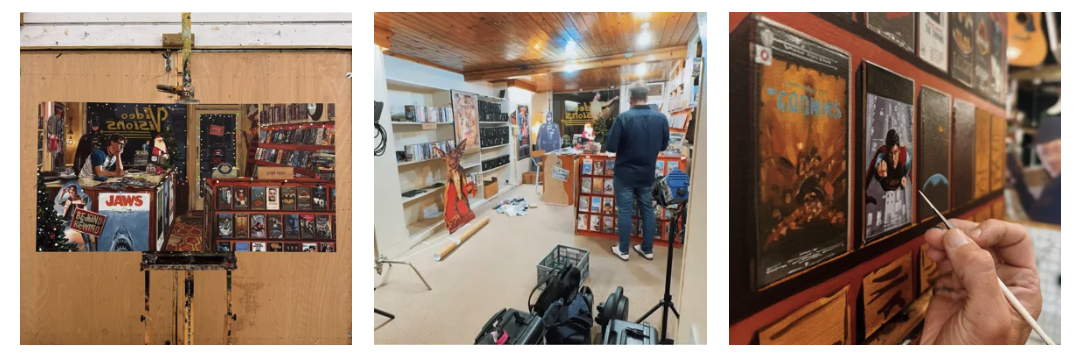
Artist Will Rochfort begins many of his paintings by constructing a set for reference. Recently, he recreated a '90s video store in an abandoned storefront in his hometown and documented the process on his Instagram.
In an interview with Jackson’s Art, Rochfort shares more of his process — working with just five colors (Prussian Blue, Yellow Ochre, Cadmium Red, Warm White, and Van Dyke Brown), casting his friends and family as models, and building props he can't find out of cardboard — plus some advice: "Do whatever you need to do, put those first steps into place to achieve the thing that you want to get. It might still be years down the line, but just make it happen. Just keep it simple, make it happen."