Take a look around any B2B category, and you'll find that most brands blur together. Same shade of blue, same stock-photography styles, same "innovative solutions for the modern enterprise" messaging. That sameness isn't an accident, and it's only getting more widespread as organizations look to speed up creative work with AI solutions. (Not so "creative," I might add.)
But what about mascots in B2B? The instinct is: too playful, too B2C, we'll look unserious. We're moving upmarket; how would a mascot support that? I suggest you challenge that instinct before dismissing the opportunity so quickly. Yes, I said opportunity. A mascot isn't always a way to make a brand "playful." Done right, it's not about being playful; it's about building one of the few assets left that a competitor can't copy. And an asset that gives you a level of recall and differentiation most brands desire.
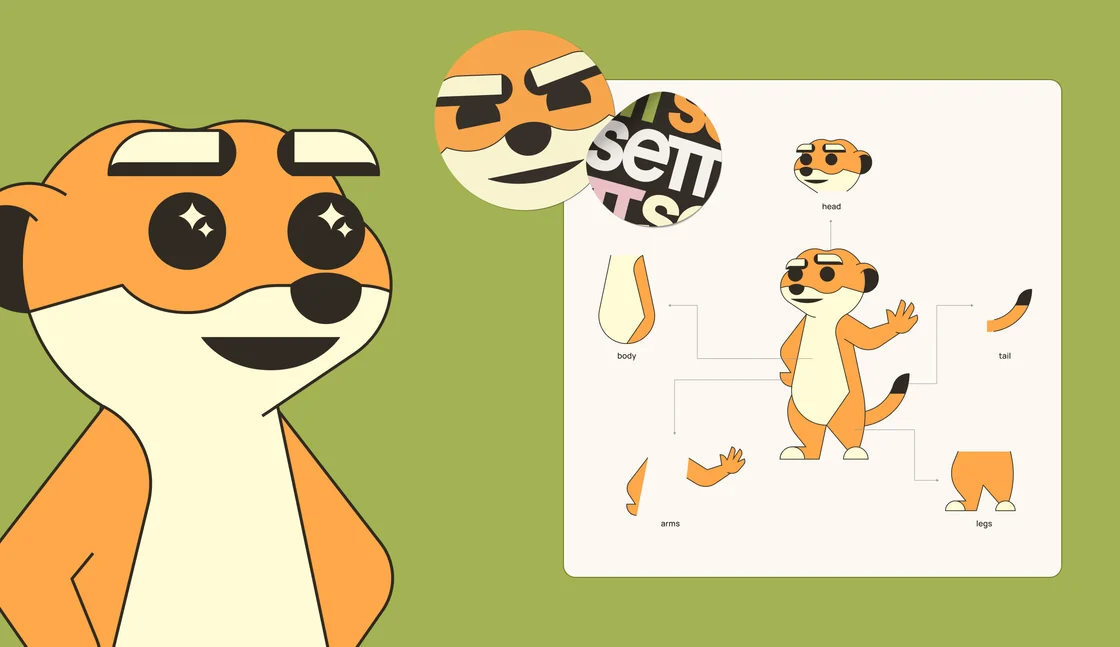
When we partnered with Sett last fall, a mascot wasn't on anyone's radar. Nobody walked in asking for one. It surfaced out of the creative process itself, working alongside partners Jonathan Fishman and Daniela Szwarc.
"A lot of our inspiration came from B2C. We had an epiphany during the rebrand effort: we need this brand to be able to say things that we can't. A mascot has a personality of its own. It can make expressions; it can be grumpy. In our industry, every brand has the same shade of blue and looks exactly the same. We needed to take it up a notch." — Jonathan
Not every brand can pull this off. It takes real cultural fit and a willingness to take the leap. Sett had both — the Meerkat was born.
Here's why it worked, and why it's worth a second look for more B2B brands:
A mascot gives your brand a personality your logo can't. A logo can't be sarcastic. It can't roll its eyes. A mascot can say the things a brand believes, but its legal team would never let it put in a headline. That's not decoration; it's a storytelling asset most competitors aren't brave enough to embrace.
The real risk with mascots isn't being seen as juvenile; it's simply usability. We pushed Sett away from a flashy 3D direction early, because a 2-person marketing team can't hire a 3D artist every time they need a new pose. Instead, we built a 2D modular system with plenty of personality and enough flexibility that their team now produces new variations in-house, constantly. That's the difference between a mascot that's a one-time launch asset and one that becomes prolific.
Finally, a brand mascot only pays off if your company commits to using it. Sett's Meerkat is on their website, their swag, their office walls, their company parties. Employees get stopped on the street because people recognize it. That's employer brand and demand gen running off the same asset.
The risk calculus most B2B brands run is incomplete. They weigh "will this look too playful" and stop there. But what about weighing what's being left on the table?
"We've grown by a factor of 20, all of it inbound organic. We didn't spend one dollar on advertising." — Jonathan
That's the payoff Sett was not willing to leave on the table.
Brand building is about differentiating.
Mascots can be a powerful tool in that effort. A strong brand makes every dollar of profit worth more. Companies with strong B2B brands "command a 65% premium in forward price-to-earnings (P/E) ratios" than weaker-branded competitors — the market literally prices their profit at a premium, according to Brand Finance. A great brand doesn't just win customers, it makes the whole business worth more.
A strong brand makes every dollar of profit worth more. Companies with strong B2B brands "command a 65% premium in forward price-to-earnings (P/E) ratios" than weaker-branded competitors — the market literally prices their profit at a premium, according to Brand Finance. A great brand doesn't just win customers, it makes the whole business worth more.
"Brand isn't a line item that performs on its own. It's a multiplier on the line items a CFO already watches: cost per lead drops when buyers show up already trusting you, win rates climb when you're on the shortlist before the first call, and sales cycles shrink when nobody has to be convinced you're credible."
The headline is admittedly a bit dramatic (the "rarest rebrand" is a rename), but Everpure's internal rollout strategy is laudable: galvanize the culture by explaining the why behind the change before the announcement.
Although growing quickly, "AI still represents a relatively small share of overall discovery," the strategy isn't fundamentally different from traditional SEO and brand-building efforts. "The brands people trust will become the brands AI trusts."
"Many organizations still think of marketing as the function that creates visibility around the business, but growth is affected by every place where people encounter the brand: the website, product experience, sales process, onboarding, support, content and even the clarity of internal communication." Brand is more than a logo and marketing is more than top of funnel.