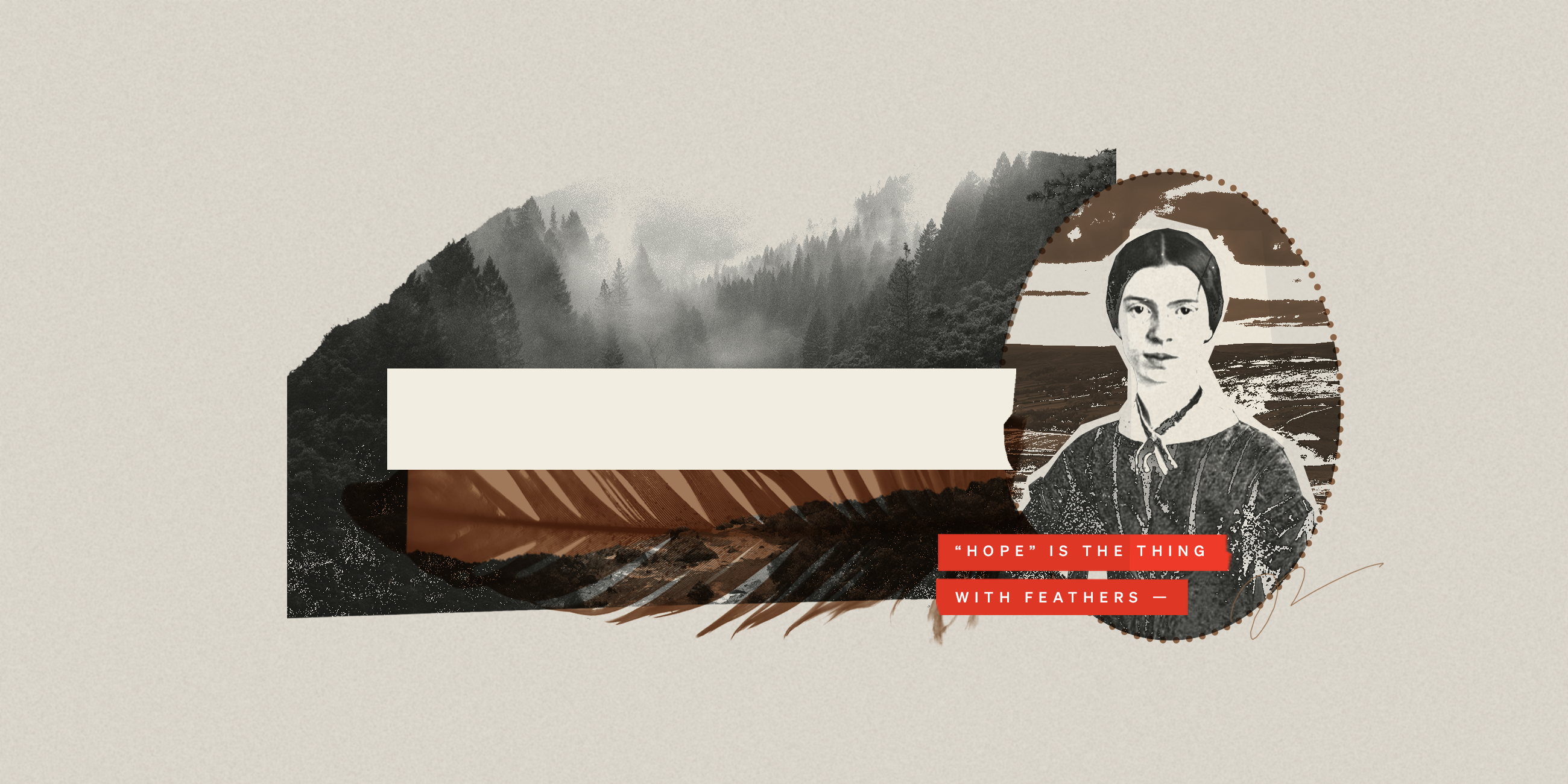
“Hope” is the thing with feathers —
Emily Dickinson opened one of her most beloved poems with a dash. Not a comma. Not a period. An interruption, a suspension, a choice. She littered her poems with bold dashes. Her original publishers hated them; they scrubbed her poems clean, smoothed the lines, made her sound more conventional. Later editors put the dashes back — because they weren’t accidents. They were architecture.
Dickinson used the dash to trust the reader — to create connection without spelling everything out.
Which is why it’s worth saying this upfront: the em dash is not a tell for lazy, inhuman, AI-generated writing.
Dickinson is the patron saint of the em dash — and the far edge of the spectrum. She was writing poetry: elliptical, emergent, allowed to leave meaning unresolved. We’re not doing that here. We’re writing prose built to explain, persuade, and hold up under scrutiny — and the em dash belongs here, too.
The em dash didn’t become a problem because machines started using it. Machines use it because great writers always have.
{{divider}}
The False Charge
The claim: em dashes are an AI tell. Use them and you signal careless, inhuman writing — or worse, that you’re passing off machine output as your own.
It’s a tempting shortcut. It feels efficient. And it’s wrong.
AI uses em dashes because it was trained on great writing — and great writing has always used em dashes. Treating the dash as suspect confuses the tool with the judgment behind it.
This is what happens when anxiety about new technology turns into pattern-hunting. Instead of reading for meaning, structure, and intent, we scan for surface signals. Punctuation becomes evidence. Style becomes guilt by association.
But writing doesn’t work that way. No punctuation mark is inherently sloppy. No sentence structure is inherently inhuman. What matters is whether the language is doing real work — advancing an idea, clarifying a relationship, earning the reader’s trust.
Blaming the em dash for bad AI writing is like blaming the hammer for a crooked shelf. The failure isn’t the tool. It’s the absence of care, taste, and craft.
{{divider}}
What the Em Dash Actually Does
The em dash earns its place because it does work other punctuation can’t.
It creates connection without instruction. A colon promises explanation. A semicolon asserts equivalence. The em dash says these ideas belong together and trusts the reader to understand how. That restraint isn’t vagueness — it’s judgment, and it shows respect for the reader’s ability to infer.
The em dash isn’t an AI tell — it’s a tool.
It gives ideas weight without stopping momentum. Parentheses soften and sideline. Periods stop the thought cold. The em dash lets something step forward mid-sentence while keeping the line moving. Emphasis, without interruption.
When the tool becomes the tell — when the em dash is treated as evidence of AI slop — anxiety displaces expertise and taste.
It introduces pause without dead air. A breath, not a break. The reader feels the shift, registers the emphasis, and keeps going. That sense of motion matters — clarity depends as much on rhythm as on syntax when ideas are doing serious work.
Writers reach for the em dash for its flexibility — the way it lets meaning shift, surface, and take shape inside a sentence.
And it adds energy without theatrics. The em dash sharpens a line without shouting. It does what exclamation points try — and often fail — to do: create emphasis through structure, not volume.
What matters most — as it always has — is having something worth saying, and the skill to say it well.
None of this is accidental. The em dash isn’t filler. It’s a precision tool. Used well, it signals that a writer understands pacing, hierarchy, and reader attention — and knows when not to overexplain.
{{divider}}
How To Spot AI Slop
A clarification, because it matters: we use generative AI in our writing work. Intentionally, and with care. Used well, it accelerates useful thinking — helping us explore, draft, test, and refine — filtered through experience and editorial accountability. Used without oversight or ownership, it produces slop: content generated without thought, published without revision, optimized for volume rather than value. Writing that sounds competent while saying nothing.
That problem is real. And it’s not revealed by punctuation.
Lazy AI writing leaves traces — but they’re structural, not stylistic. They show up in how ideas connect, whether claims are earned, and what happens when you press on a sentence to see if it holds weight.
Here’s what gives it away:
1. Claims without consequence
Big statements float by untested. “Organizations must prioritize strategic alignment.” “Success requires a customer-centric approach.” These sentences commit to nothing because they apply to everything. There’s no context, no evidence, no tradeoff — no stakes. Good writing names a specific problem, in a specific context, with something at risk.
2. Smoothness without direction
The prose flows. Transitions connect. Everything reads cleanly — and yet the argument goes nowhere. The writing hedges instead of choosing. Every tension is acknowledged and politely neutralized. You finish reading a section understanding no more than when you started. It feels assembled, not composed — because no decision is ever reached.
3. Thought that doesn’t survive inspection
Remove a paragraph and nothing breaks. That’s a useful test. An articulated argument demands dependency — each idea builds on the last. Slop is interchangeable. Passive constructions, missing agents, abstract verbs where specifics should be: they all show up here.
You can write all of this without a single em dash. And you can write sharp, clear, human prose full of them. What separates them isn’t punctuation. It’s whether the writing makes real claims — and earns them — and whether the logic reflects deliberate thought.
The problem isn’t punctuation. It’s the absence of intent.
{{divider}}
When We Mistake Signals For Substance —
Emily Dickinson’s editors were wrong the first time because they mistook unfamiliar form for flawed thinking. They fixed what didn’t need fixing — and flattened meaning in the process. Later editors understood what Dickinson achieved with her chosen punctuation: the dash wasn’t excess. It was intention.
We’re in a similar moment now.
The fear driving this debate is real. AI is changing the sheer quantity of writing entering the world, how fast it appears, and how little friction stands in the way. Some of it is careless. Some of it is empty. Some of it makes reading harder instead of easier. That deserves scrutiny.
But counting punctuation marks isn’t scrutiny. It’s avoidance.
The em dash isn’t a shortcut, a crutch, or a tell. It’s a tool — one that signals judgment when used well and reveals nothing when used poorly. What matters isn’t whether a dash appears on the page. It’s whether the writing earns it. Whether the ideas connect. Whether the structure holds. Whether anyone was thinking at all.
If there’s a lesson worth taking from Dickinson’s editors, it’s this: when form unsettles you, look harder. Don’t smooth it out. You might be sanding away the very thing doing the work.